


Mastering Steering Pinion Manufacturing: The VAJRA 130R Single-Platform Solution
Reliable vehicle performance relies entirely on the structural integrity and precision of the steering pinion. As a critical link in automotive steering systems, the pinion demands exact tooth profiling to ensure zero-backlash operation and absolute safety. However, as quality expectations rise alongside high-volume production demands, manufacturers face a persistent challenge: consistently achieving flawless gear accuracy without sacrificing shop floor throughput.
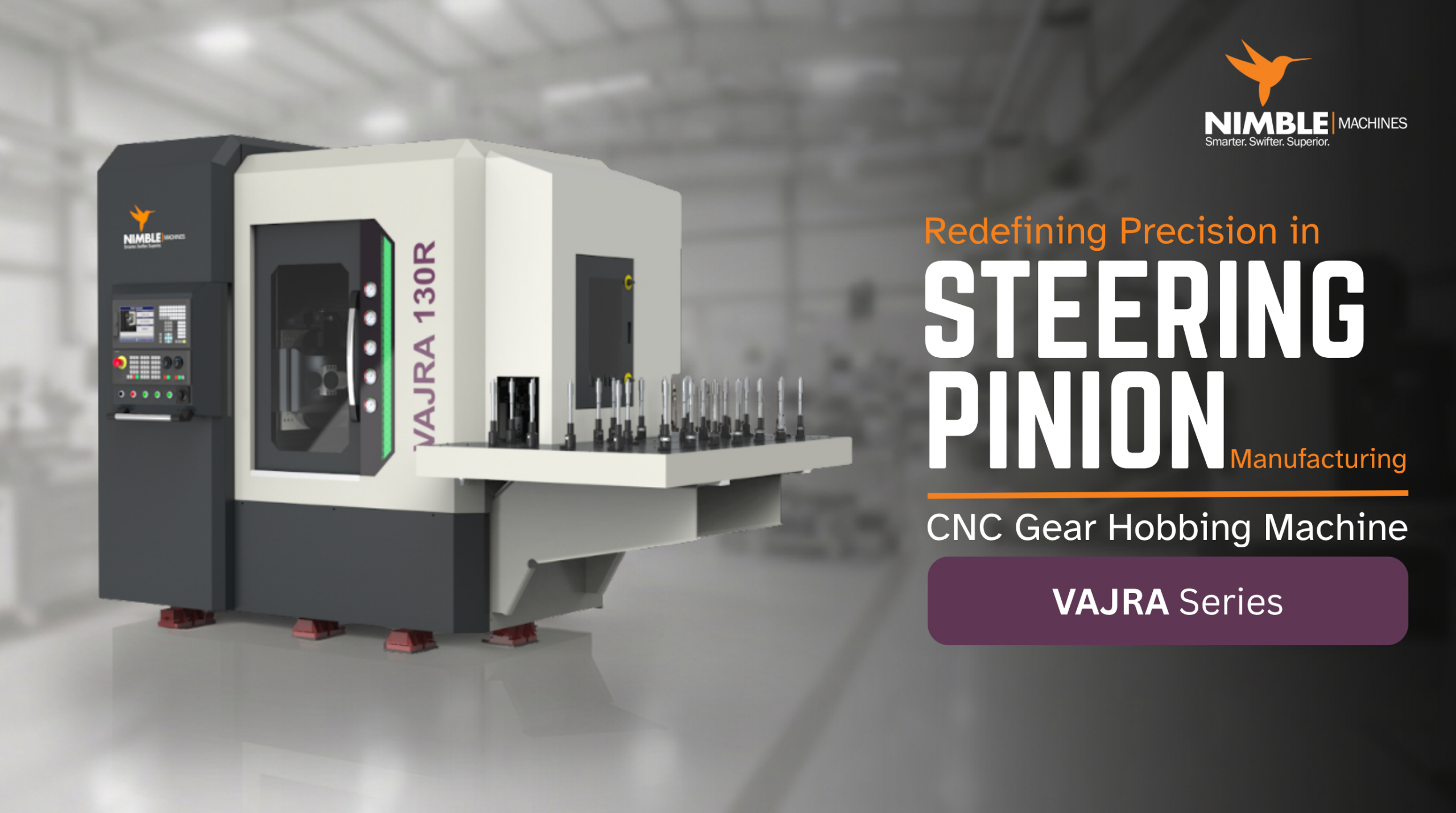
For automotive suppliers, the conventional multi-machine approach to gear manufacturing is rapidly becoming a bottleneck. The solution lies in consolidating the manufacturing process. The VAJRA 130R CNC Gear Hobbing Machine by Nimble Machines is specifically engineered to meet this demand, offering a complete, single-platform solution for steering pinion production
The 4 Challenges of Steering Pinion Production
Modern automotive manufacturing presents four critical hurdles when cutting steering pinions at scale:
- Precise Tooth-to-Reference Alignment: Ensuring the gear teeth perfectly align with the component’s existing reference features is notoriously difficult at high speeds.
- Heat Treatment Distortion: The thermal processes required to harden automotive gears inevitably warp the metal, destroying the accuracy achieved during initial cutting.
- High-Volume Production Demands: Automotive contracts require massive throughput, meaning cycle times must be ruthlessly minimized.
- Dependence on Secondary Finishing Operations: To correct heat distortion, manufacturers traditionally rely on expensive, separate grinding or shaving machines, increasing capital expenditure and process complexity.
Our Solution: Built for Reliable Steering Performance
The VAJRA 130R dismantles these bottlenecks by integrating advanced technology that allows manufacturers to perform both the initial cut and the final precision finish on the exact same machine.
Intelligent Tooth Alignment Achieving perfect synchronization is no longer left to manual calibration. The VAJRA 130R utilizes custom alignment algorithms paired with advanced sensor technology. This ensures the precise synchronization of component reference features before the hob even touches the metal, guaranteeing perfect tooth-to-reference alignment every time.
Engineered for High-Volume Production To meet the relentless pace of automotive supply chains, the machine is built around advanced Direct-Drive technology. When combined with high-speed hobbing capabilities and automated robotic loading systems, the VAJRA 130R maximizes your shop floor productivity, drastically reducing idle time and accelerating overall throughput.
Precision After Heat Treatment Thermal distortion is a reality of gear manufacturing, but it no longer requires a separate grinding machine to fix. The VAJRA 130R features highly rigid architecture that enables advanced Hard Hobbing. This allows the machine to effortlessly cut hardened materials, compensating for heat distortion and consistently achieving superior gear quality up to DIN 6 standards.
Finish on the Same Platform By far the most significant advantage of the VAJRA 130R is its ability to perform both soft hobbing and hard hobbing (or skiving) on the same platform. This eliminates the need to route parts to secondary finishing machines, radically reducing process complexity, lowering capital expenditure, and minimizing machine-dependence on your shop floor.
The Streamlined Workflow
By utilizing the VAJRA 130R, manufacturers can transition to a simplified, highly accurate production cycle that eliminates traditional bottlenecks:
- Step 1: Soft Hobbing – High-speed material removal prior to hardening.
- Step 2: Heat Treatment – The component is removed and hardened (off-machine).
- Step 3: Sensor Alignment – The hardened part is reloaded, and intelligent sensors perfectly re-synchronize the gear teeth with the tooling.
- Step 4: Hard Hobbing (Finish) – The machine executes the final precision finish, achieving DIN 6 quality on the hardened component.
Investing in the VAJRA 130R means investing in a streamlined, future-proof production line. By combining high-speed output with single-platform finishing, manufacturers can secure tighter tolerances, reduce their cost-per-part, and confidently take on the most demanding automotive contracts in the industry.
Frequently Asked Questions (FAQs)
What is the difference between soft hobbing and hard hobbing?
Soft hobbing is the process of cutting the initial gear teeth into a raw, unhardened metal blank. Hard hobbing occurs after the part has been through heat treatment (hardening). It uses specialized carbide tools and a highly rigid machine to shave away the minute distortions caused by the heat, resulting in a perfectly accurate final gear.
How does single-platform manufacturing reduce costs?
Traditional manufacturing requires buying one machine for soft hobbing and a separate secondary machine for the final finish. By doing both on the VAJRA 130R, you eliminate the cost of purchasing, maintaining, and staffing that second machine, while also freeing up valuable shop floor space.
What does a DIN 6 quality rating mean for automotive gears?
DIN (Deutsches Institut für Normung) is a stringent German standard for gear quality, with lower numbers indicating higher precision. Achieving a DIN 6 rating means the gear possesses extremely tight tolerances regarding profile, lead, and pitch errors. This level of accuracy is essential for ensuring smooth, quiet, and reliable operation in automotive steering systems.
