



OEM Recommended Preventive Maintenance for High-Speed CNC Gear Hobbing Machines
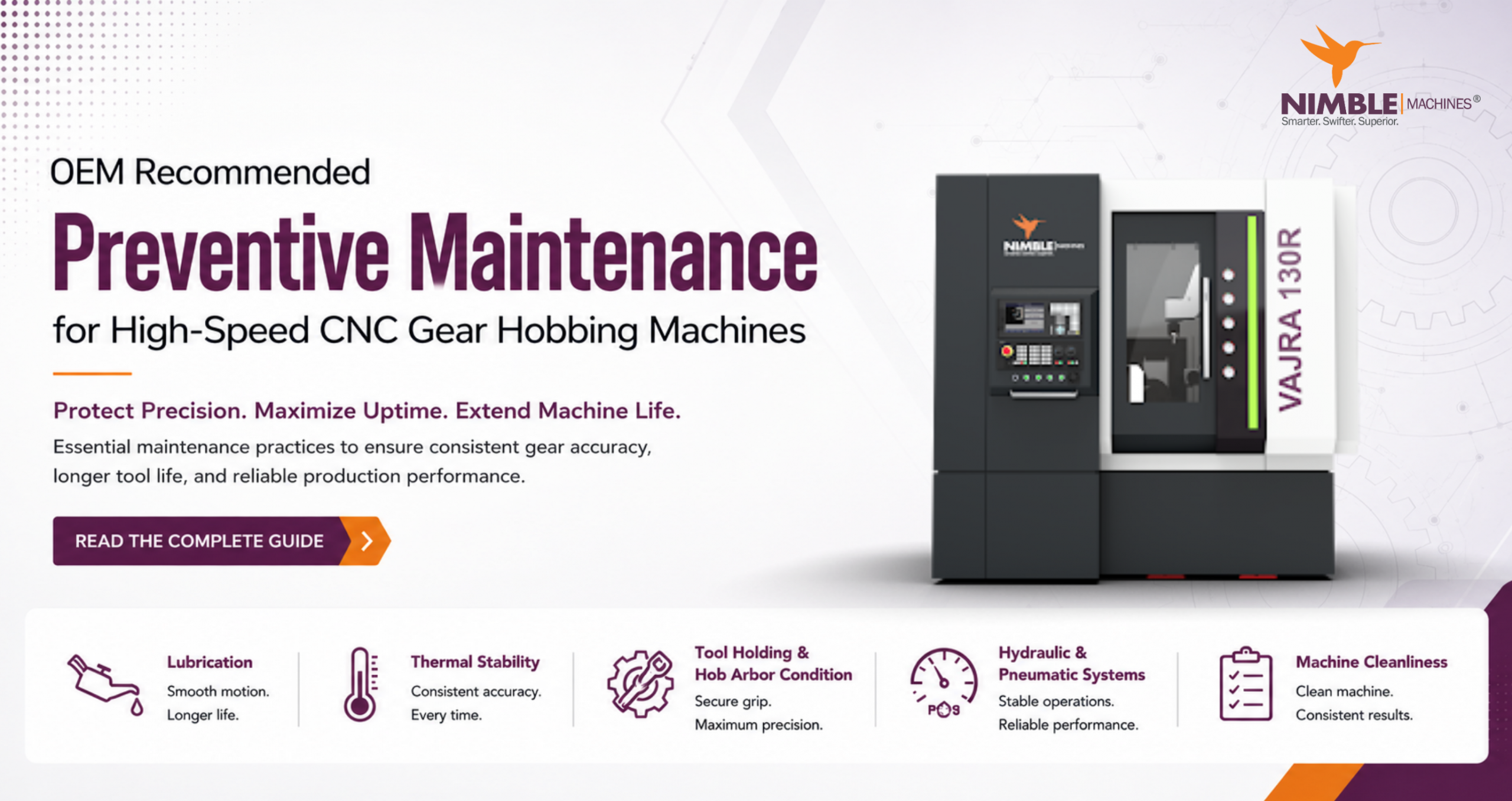
Unlike many conventional machining operations, gear hobbing is a continuous generating process where multiple machine axes must remain perfectly synchronized throughout the cutting cycle.
Any loss of positioning accuracy or machine stability can affect critical gear quality parameters such as:
- Tooth Profile Accuracy
- Lead Accuracy
- Pitch Consistency
- Runout
- Surface Finish
Maintaining these parameters requires more than a high-quality hob—it requires a machine that consistently performs as designed.
Five Maintenance Areas That Directly Impact Gear Quality
1. Lubrication – The Foundation of Precision
The linear guideways, ball screws, bearings, and other moving components rely on continuous lubrication to maintain smooth and accurate motion.
Insufficient lubrication increases friction and wear, which can gradually affect axis positioning accuracy and repeatability. Monitoring lubrication oil levels, ensuring proper operation of the centralized lubrication system, and checking for leaks should form part of every preventive maintenance routine.
Proper lubrication not only extends component life but also preserves the machine’s ability to maintain consistent gear quality over extended production cycles.
2. Thermal Stability – Consistency Starts Before Cutting
Temperature has a direct influence on machining accuracy. Changes in spindle temperature, machine structure, or coolant conditions can lead to dimensional variation during production.
To maintain stable machining conditions:
- Allow the machine to complete the recommended warm-up cycle before precision production.
- Maintain adequate coolant levels and proper coolant circulation.
- Ensure coolant temperature remains stable during continuous machining.
- Keep coolant clean and free from excessive chip contamination.
Maintaining a stable thermal environment helps deliver consistent gear geometry from the first component to the last.
3. Tool Holding and Hob Arbor Condition
The interface between the spindle and the hob is one of the most critical elements in precision gear cutting. Before production, always ensure:
- The spindle taper and hob arbor are clean.
- Contact surfaces are free from burrs and damage.
- The hob is securely clamped.
- The arbor is inspected periodically for wear or runout.
- Even minor contamination or runout at the tooling interface can affect gear accuracy, increase vibration, and reduce hob life.
Regular inspection of the hob arbor is therefore just as important as maintaining the machine itself.
4. Hydraulic and Pneumatic Systems
Reliable hydraulic and pneumatic systems are essential for maintaining machining stability.
Hydraulic pressure directly influences fixture clamping, tailstock support, and workpiece stability, while pneumatic systems support various machine functions including air blow, sensors, and auxiliary actuators.
Routine inspection of oil levels, air pressure, hoses, fittings, and filters helps ensure these systems continue to operate reliably and consistently.
5. Machine Cleanliness – A Simple Habit with a Big Impact
Cleanliness is often overlooked, yet it plays a significant role in maintaining machining accuracy.
Regular removal of chips from the work area, fixtures, coolant channels, and machine enclosure prevents chip accumulation that can interfere with workholding, coolant flow, and sensor performance.
Keeping electrical cabinets clean and ensuring coolant systems remain free from excessive contamination also contributes to long-term machine reliability.
A clean machine is easier to inspect, easier to maintain, and more capable of delivering consistent performance.
Direct Drive Technology: Precision with Lower Maintenance
Conventional gear hobbing machines often rely on mechanical transmission elements such as gears, belts, and couplings that require periodic inspection and maintenance.
The VAJRA Series CNC Gear Hobbing Machines utilize Direct Drive Technology for the hob spindle and work table, eliminating these mechanical transmission components.
This provides several long-term advantages:
- No mechanical backlash from transmission elements
- Reduced wear components
- Lower routine maintenance requirements
- Higher positioning accuracy
- Improved long-term reliability
With fewer mechanical components to maintain, manufacturers can focus more on production and less on machine upkeep.
Preventive Maintenance vs. Reactive Maintenance
The most successful manufacturing facilities follow a preventive maintenance approach rather than waiting for failures to occur.
Simple daily inspections of lubrication, coolant condition, hydraulic pressure, tooling, and machine cleanliness can prevent costly downtime and maintain consistent machining performance.
Periodic inspections of hoses, filters, machine geometry, spindle condition, and axis accuracy further help preserve the machine’s precision throughout its operational life.
Recommended Maintenance Frequency
A structured maintenance schedule helps ensure long-term machine reliability.
| Frequency | Typical Activities |
| Daily | Check lubrication and hydraulic oil levels, coolant level, machine cleanliness, hob arbor condition, and tool clamping. |
| Weekly | Inspect coolant filtration, hydraulic and pneumatic systems, electrical cabinet cooling, and auxiliary drives where applicable. |
| Monthly | Inspect hoses, belts, limit switches, safety devices, and overall machine condition. |
| Annually | Verify machine geometry, spindle runout, axis backlash, and overall machine accuracy as part of preventive servicing. |
These routine inspections require minimal downtime but significantly contribute to maintaining long-term machine performance.
Precision Begins with Proper Maintenance
High-quality gears are the result of more than advanced CNC controls and precision tooling. They depend on a machine that remains stable, accurate, and reliable throughout years of continuous production.
By following a structured preventive maintenance program, manufacturers can achieve:
- Consistent gear quality
- Longer hob tool life
- Reduced unplanned downtime
- Higher Overall Equipment Effectiveness (OEE)
- Lower operating costs
The VAJRA Series CNC Gear Hobbing Machines are engineered with TPM-friendly access, robust construction, and maintenance-friendly Direct Drive technology to simplify routine upkeep while delivering the precision and reliability demanded by modern gear manufacturers.
Whether you are producing automotive gears, hydraulic pump gears, industrial gearbox components, or agricultural transmission shafts, proper maintenance ensures your machine continues to deliver the accuracy and productivity your business depends on.
Frequently Asked Questions (FAQs)
Why is preventive maintenance more critical for gear hobbing than conventional machining?
Gear hobbing is a continuous generating process that requires multiple machine axes to remain perfectly synchronized throughout the entire cutting cycle. Any loss of positioning accuracy due to poor maintenance directly degrades critical gear parameters, including tooth profile, lead accuracy, pitch consistency, and surface finish.
How does temperature fluctuation affect gear production?
Changes in spindle temperature, machine structure, or coolant conditions lead directly to dimensional variations in the workpiece. Completing recommended machine warm-up cycles and maintaining stable, clean coolant ensures consistent thermal stability and accurate gear geometry from the first component to the last.
Does implementing a digital monitoring system significantly impact the Total Cost of Ownership (TCO)?
Yes. Despite initial costs, sensors and software enable “Condition-Based Maintenance,” allowing service only when needed. This reduces downtime, avoids premature part replacement, and maintains peak efficiency, significantly lowering the total cost of ownership and maximizing ROI.
