



Maximizing Profitability: The Engineering Approach to CNC Gear Hobbing Tool Life
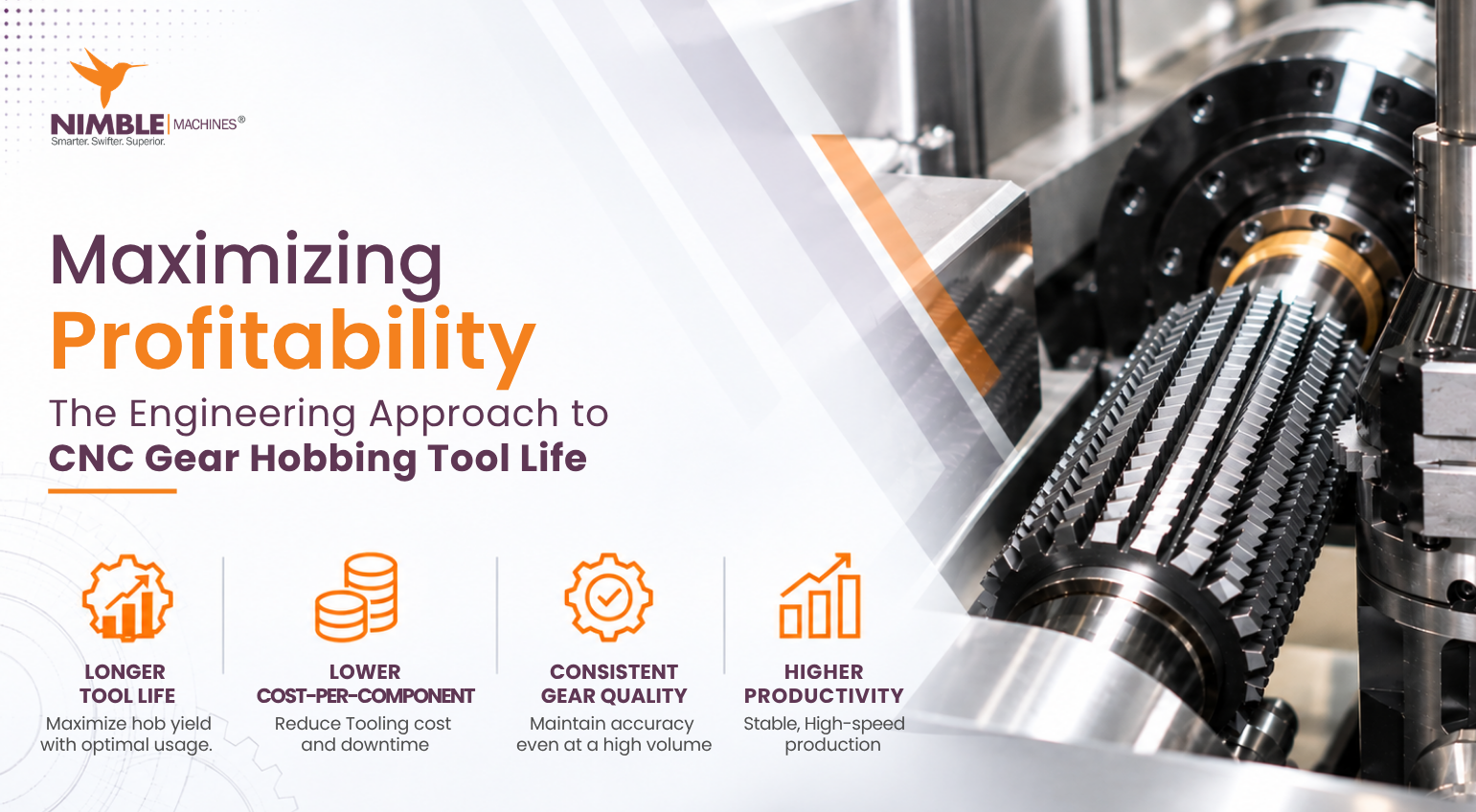
In high-volume gear manufacturing, cutting tools represent one of the most significant recurring operational expenditures (OPEX). For facilities operating in competitive industrial hubs like Pune, Chennai, and Bengaluru, maximizing the yield of a single carbide hob directly dictates the profitability of a production run.
This places production engineers and machine operators at a critical economic crossroad: the tool replacement dilemma. Replacing a hob prematurely leaves valuable cutting life on the table, artificially inflating the cost-per-component. Conversely, delaying a tool change risks catastrophic tool failure—a scenario that not only destroys an expensive carbide cutter but routinely scraps high-value components and risks severe damage to the machine spindle.
Eliminating this guesswork requires a transition from reactive operator intuition to a systemic, data-driven approach to carbide hob wear management. Here is the technical framework for optimizing tool utilization, stabilizing part quality, and extending CNC gear hobbing tool life on the shop floor.
1. The Mechanics of Tool Wear in High-Speed Gear Cutting
To manage tool life effectively, operators must first understand the physics of tool degradation. In high-speed gear cutting, the hob is subjected to extreme mechanical friction, severe thermal shock, and continuous cyclical loading.
- Flank Wear: This is the most common and predictable form of wear. As the clearance face of the hob rubs against the workpiece, abrasive friction slowly degrades the carbide. While uniform flank wear is expected, excessive wear alters the cutting geometry, resulting in dimensional profile drift on the machined gear.
- Crater Wear: Occurring on the rake face of the cutting tooth, crater wear is driven by the extreme heat of the metal chips flowing over the tool. Severe cratering weakens the cutting edge, leading to micro-chipping and sudden failure.
- Built-Up Edge (BUE): When machining at sub-optimal speeds or with degraded coolant, workpiece material micro-welds to the cutting edge. This built-up material eventually breaks off, taking microscopic pieces of the carbide substrate with it and rapidly accelerating tool ruin.
2. Implementing a Strategic Hob Shifting Protocol
Because the face width of a standard gear is significantly narrower than the usable length of the hob, continuous cutting in a single position will rapidly destroy a concentrated section of the tool. The most effective method for extending CNC gear hobbing tool life is the implementation of precise tangential shifting.
By shifting the hob along its tangential axis, operators distribute the cutting load across unused teeth. Modern CNC controls offer two primary shifting methodologies:
- Step Shifting: The hob cuts a predetermined number of parts before the machine automatically shifts the cutter a specific distance (e.g., shifting 2mm after every 10 parts).
- Continuous (Diagonal) Shifting: The machine interpolates the tangential axis continuously during the axial feed. This ensures the cutting load is perfectly distributed across the entire usable length of the hob, preventing localized wear and maximizing the yield of the tool before regrinding is required.
Operators must rely on the CNC control to automate these shifts, removing human error and ensuring the tool degrades at a strictly controlled, mathematically predictable rate.
3. Diagnostic Indicators: When to Execute a Tool Change
Even with automated shifting, operators must monitor the physical cutting process to determine the exact moment a tool reaches its terminal wear threshold. Relying solely on a predetermined part counter is insufficient, as material hardness variations can accelerate wear unexpectedly. Operators should monitor three critical diagnostic indicators:
- Spindle Load Monitoring: As a cutting edge dulls, the machine must exert significantly more force to shear the metal. Operators must monitor the live spindle load on the CNC interface. A sudden, unprogrammed spike in spindle torque is the earliest indicator that the hob is failing.
- Chip Morphology: The metal chips generated during cutting tell a highly accurate story of tool health. If the chips transition from a clean, curled shape to a jagged, burnt, or dark blue appearance, it indicates that heat is no longer being evacuated effectively. The tool is rubbing rather than cutting, and replacement is imminent.
- Acoustic Signatures: A sharp carbide hob operating under optimal parameters produces a consistent, smooth cutting sound. When the acoustic signature transitions into a harsh, heavy grinding or chattering noise, the cutting edge has degraded beyond acceptable limits.
4. The Machine’s Role in Tool Life: The Nimble Machines Advantage
The most meticulous carbide hob wear management strategy will fail if the machine tool itself lacks structural rigidity. Vibration is the ultimate enemy of carbide tooling; even microscopic mechanical chatter will exponentially accelerate edge chipping and tool failure.
This engineering reality is what drives the architecture of the VAJRA Series from Nimble Machines. Built to protect your tooling investment and dominate high-speed gear cutting applications, the VAJRA Series provides unparalleled operational stability:
- Zero-Backlash Direct Drive: By eliminating mechanical gear trains and belts, the VAJRA Series removes the mechanical play that traditionally induces tool chatter. This perfect axis synchronization drastically reduces cyclical impact on the carbide edges.
- Massive Structural Dampening: Engineered with a highly rigid, thermally stabilized cast-iron bed, the CNC Gear Hobbing machine absorbs the severe cutting forces generated during heavy material removal, preventing resonant vibration from reaching the tool interface. UCRIDE® Technology enhanced Performance. The machine is equipped with Composite Epoxy filling UCRIDE ® technology at suitable regions to support damping and reduce vibrations, hence, enabling higher precision.
By pairing advanced CNC shifting capabilities with the uncompromising structural rigidity of the VAJRA Series, manufacturing facilities can safely push their cutting parameters to the limit—maximizing throughput, extending tool life, and driving down the cost-per-component.
